Wednesday, July 17, 2019

The Juneteenth Awakening


The Juneteenth Awakening, when was your awakening to Juneteenth? When did you first learn about the Juneteenth Day Celebration? I would venture to guess that if polled at least 75 percent of black Americans still haven's heard about Juneteenth, and if I increase the poll audience to include everyone, black and white the number of people unaware of Juneteenth history goes up closer to 80 or 90 percent. You would think that such an important historical event would have been front and center in my school history book, but, when I was a child Juneteenth was not mentioned in my elementary, Jr. High, or High School history book and for sure it wasn't a subject covered in any of my history classes up to and including college.

It's really easy to suffer from the feeling of entitlement and superiority when you grow up believing that you/your race has invented, created, discovered, and built everything on earth. Especially when those promoted facts are presented in the history books you go to school to learn from. Luckily in this day and age, historic facts about African and African American accomplishments are starting to leak out and nowadays that also includes information and facts about the Juneteenth Day Celebration.

In my case, I really can't put all the blame on the places of education I have attended over my lifetime. Both of my parents were from the south one from the very state where Juneteenth was memorialized on June 19, 1865. I had always heard that my parents left the south for a better life, but I had always thought that meant moving from the farm to the big city, when in reality what those words really meant was not wanting to raise their children in the Jim Crow south. (thank you, aunt Opal, for that info)

The fact that the work was plentiful, and paid better during WWII was also a BIG PLUS. Juneteenth may have come from the south (Texas) but during the 50s and the Civil Rights 60s, Juneteenth Celebrations were held to a minimum, if at all. Whatever their reason my parents, who were from Juneteenth country, never mentioned the Juneteenth celebration to any of us children.

So my Juneteenth Awakening would be almost 38 years in coming. Prior to that, I would certainly have failed the poll question: "have you ever heard of the oldest African American Celebration in the nation Juneteenth?"

My hope is that as more Americans become aware of the Juneteenth Celebration and that the celebration celebrated by some states becomes a national holiday. Juneteenth history should be taught in schools so that generations of black and white Americans will be made aware of the sacrifices and plight of the African ancestors so that all of their African descendants still suffering from racism will not only remember their struggle but learn how to better use some of the advances African Americans have already made and as a nation go after racism the same way this nation went after slavery.

I also hope that our history doesn't forget about all of the white abolitionists who were instrumental in putting an end to slavery by maintaining the underground railroad that transported runaway slaves to freedom until it was no longer needed for the clandestine system and for helping to create the oldest African American Celebration in this nation, Juneteenth.

Wednesday, June 5, 2019

A Slave Ship Captain


John Newton Clark is one of the people I noted in my Juneteenth Handbook. As a child young Newton was placed in a divinity school by his mother where they lived. His father was a ship's captain and lived his life at sea. Rebellious in his youth John had often spoken against and engaged in heated arguments about the church and religion in an attempt to break free from the path he felt was chosen for him. After his mother died suddenly his father returned from the sea and took his son John to sea with him where the younger Newton grew into his teens as an accomplished sailor and skilled navigator.

When John Newton was old enough he was pressed into military service on one of Great Britain's Royal Navy Man-of-war sailing ships. Perhaps being more accustomed to giving orders, than taking orders, John Newton found it hard to adjust to the militaristic no-nonsense way of handling a ship and he deserted the British Royal Navy. Living on the run until he was captured a John Newton in his early 20s was sentenced to serve on board a British Merchant Sailing ship engaged in the Trans Atlantic Slave Trade. Onboard, the slave ship with none of the polish or organization of the Royal Navy Fighting Ship he had once served aboard. John witnessed first-hand the inhumane treatment of the ship's human cargo, the African Slaves.

He soon came to realize that as bad as his sentence for desertion was his cramped crews quarters, second rate food, and officers who seemed to show little mercy to a Royal Navy deserter, what he saw being done to the captive people on board the slave ship, the animal conditions in which the African men and women were chained and quartered, the slop they were fed and the misuse and abuse visited upon them by the ship's crew, in some cases, for the mere act of being sick, John realized that as bad as his lot in life was at the time, there was truly a worse condition if your skin was black.

When his time onboard the slave ship was done, it was British custom at the time that, whatever port his ship found itself in after he had served his sentence for desertion, that was the port in which he would be discharged. John Newton found himself marooned on the west-coat of Africa without a ship, and without his country. The abandoned British sailor was able to find employment with a slave trader, however, he was distrusted, and disliked, by the slave merchant’s African wife and soon found himself living and eating with the slaves.

He would remain in Africa until a crew member from the British sailing ship Greyhound spotted the unusual sight of a white man working alongside the slaves. In an act that, John Newton would forever view as an act of mercy he was given passage on board the ship and returned to England. During the long ocean voyage home, John Newton found the book Imitation of Christ, by Thomas A. Kempis, and as his shipboard hours past he recalled the brutal conditions imposed upon him having his freedom taken from him and he took from the book the seed of Christianity that began to renovate his soul.

Maturity stilled the uncertainty of his youth and John grew as a Christian. It wasn’t long before his life’s experiences helped him get promoted to the rank of ship’s master, a master of his own ship, a slave ship. It was during his days as a slave ship captain sailing the Atlantic that his newfound Christian beliefs often clashed with the act of slavery that was now his livelihood. The slave trade was acceptable in England in the middle 1700s; slave commerce filled the British need for American goods like Tobacco and cotton.

Deeply troubled by the inhumane aspect of the slave trade John Newton found himself at an impasse that would finally result in his decision to leave the sea, where he had grown up, and that had been his home for most of his adult life. Attitudes about the slave trade were more than three hundred years slow in changing but the British would eventually outlaw the trading of people as slaves in 1807; going so far as to set up blockades along the African coast to enforce their controversial new policy. In 1808, more than fifty years before the Civil War, an act of the U.S. Congress would make it illegal to continue to import slaves from outside of the Americas. American navy ships would join the British navy to strengthen the blockade against the transatlantic slave trade.

After giving up his life at sea and his career as a slave ship's captain John Newton returned to the ministry. As a child, John Newton had chosen to ridicule Christianity and had been adrift from his religion for decades. To pay his bills Newton found work as a tide surveyor and after completing his study for the ministry he would spend the last forty-three years of his life promoting the gospel in London and Olney England. Giving thanks for what he felt was the undeserved mercy and favor from a merciful God. During his lifetime, John Newton wrote many hymns but none were more popular than the one he titled Amazing Grace, in 1770.

AMAZING GRACE, HOW SWEET THE SOUND THAT SAVED A WRETCH

LIKE ME

I ONCE WAS LOST, BUT NOW AM FOUND WAS BLIND, BUT

NOW I SEE

TWAS GRACE THAT TAUGHT MY HEART TO FEAR AND

GRACE MY FEARS RELIEVED

HOW PRECIOUS DID THAT GRACE APPEAR THE HOUR I FIRST BELIEVED

THROUGH MANY DANGERS, TOILS, AND SNARES I HAVE ALREADY COME

TIS GRACE HATH BROUGHT ME SAFE THUS FAR AND GRACE WILL LEAD ME HOME

Where the slave ship captain turned-servant-of-the-church tombstone rest there is an inscription on it that reads:

“John Newton Clark, once an infidel and libertine, a servant of slaves in Africa, was by the rich mercy of our Lord and Savior Jesus Christ preserved, restored, pardoned and appointed to preach the faith he had long labored to destroy.”

Monday, June 3, 2019

African American Women Breastfeeding Facts


Breastfeeding and the Black Body: Are We Still Carrying Generational Trauma?

Do African American women still suffer from hidden, inherited beliefs about their bodies—especially when it comes to breastfeeding?

That question hit me hard after reading some statistics recently:

  • 80% of Hispanic women breastfeed their babies

  • 79% of white women do the same

  • But only 59% of African American women breastfeed

That gap made me pause. I've read before that breastfeeding helps form a deep bond between mother and child. So, why the difference? And could there be a deeper, more painful history at play?


A Personal Reflection

As I thought more about it, I realized something unsettling: I’ve never seen a Black woman in my family breastfeed. Not my mother. Not my aunts. Not even my wife. She pumped milk, but as far as I can recall, she never nursed our children directly.

This absence seemed odd—until I remembered something I’d come across in my research on slavery: images and accounts of enslaved Black women breastfeeding white children. Often, they were forced to give their milk to the enslaver’s baby, while their own children went without—or were allowed to nurse only from the “other” breast. There were even reports of punishment if the wrong child was fed from the wrong side.

Think about that for a second.


From Trauma to Tradition?

Could trauma like that echo through generations? Passed down not as a conscious choice, but as a quiet aversion, a gut feeling, or a belief wrapped in shame?

Even today, I’ve noticed something telling. In conversations and casual observations (especially while managing my online fashion store), I’ve seen increased interest in breastfeeding-friendly maternity wear. But not from Black women. That’s anecdotal, sure—but it’s something I noticed.

I also remember reading about a young Black mother who said she was comfortable breastfeeding—just not at her aunt’s house. Her aunt had told her that breastfeeding was “nasty.” That word really stuck with me. Nasty.

Where did that idea come from? And why has it held on?


Modern Factors or Historical Echoes?

Yes, there are modern reasons why many women—of all races—might opt for bottle-feeding: lack of time, lack of privacy, or just the convenience of formula. But I can’t shake the idea that there might also be something deeper for Black women: a kind of inherited discomfort rooted in the past.

Could the enforced separation between Black women and their own children during slavery have shaped how generations would later view motherhood and the body?

If so, that’s powerful. And heartbreaking.
And it raises one more question:

What else might we be carrying without even knowing it?


Let’s Talk About It

I don’t claim to have all the answers—just questions that I think deserve space and honesty.

If you’re reading this and you’ve experienced this topic firsthand, I’d love to hear your thoughts. Whether you breastfed your children, were discouraged from doing so, or are just curious about the historical connections, your voice matters.

Drop a comment or message me directly. Let’s keep the conversation going.


Friday, May 31, 2019

2019 Juneteenth Day Celebration


Back in 1863 when Abraham Lincoln wrote his Emancipation Proclamation that contained the words "I do order and declare that all persons held as slaves within said designated states, and parts of states, are, and henceforth shall be free" he intended the news within his proclamation to be heard by all of the slaves in the southern U.S. Southern slave owners, slave merchants, and newspapers did not share that good news with the slaves.

Word still managed to reach some of the slaves in the south, but the unbelievable message was treated more as hearsay and rumor, until June 19, 1865, when General Gordon Granger assumed jurisdiction over the state of Texas and in his reading of General Order #3 confirmed to the large slave population gathered there in Galveston Texas that the hearsay and rumor of freedom whispered amongst the southern slaves about Abraham Lincoln's words of freedom were true bringing to an end two-and-a-half-years cruel doubt and secret rumor.

The joy and jubilation experienced that day by our African and African American slave ancestors would mark the first celebration of Juneteenth. Juneteenth Day Celebration is now celebrated thought out the U.S. and in many places on the date of June 19th.  One of those places, out here in California, will be the former black township of Allensworth California founded in 1908. The all-black town started by Colonel Allen Allensworth no longer exists as it once did in the early 1900s. The township has been turned into a State Park operated nowadays The Friends of Allensworth Association and the California Parks and Recreation Department.

Allensworth is a neat slice of African American history in my opinion that mixes well with the Juneteenth Day Celebration. Not only because of the town's place in African American History but because of its State Park status and ability to host a lot of people. I think that makes the historic town of Allensworth a great way to answer the question of how to celebrate Juneteenth. The town and the towns creator, Colonel Allen Allensworth are both significant representations of African American history. Juneteenth to me is about family and celebrating the freedoms our African, and African American ancestors did not live long enough to enjoy. The Juneteenth Day Celebration is also a great teachable moment in the lives of our children and a chance for you to share your Juneteenth knowledge with anyone you run into that is looking for more information about the Juneteenth celebration, or the Juneteenth flag.

I have often tried to imagine what it would be like to invite one of my slave ancestors from the distant past here to the present day and time where we all live today to see what they might say and think the progress African American people have made since the end of slavery?  Would they be surprised to see that the KKK is still alive and well, and still working in government? Would they be able to comprehend that our last president was a black man with a white mother? Would their minds be totally blown by my flat-screen-television; or the fact that people on the TV-screen were talking about paying millions of dollars for both black and white sports figures?

These are not the kind of thoughts that keep me up at night but they do sometimes come in handy when I'm working on a screenplay. I realize that it would be a disaster for me to try and explain all of the above to a slave ancestor, our lifetimes would just be too far apart. When I celebrate Juneteenth I am always mindful of the sacrifices the Africans who came to America against their will centuries before I was born, and for the ones that I know did not complete the middle passage. My hope is that their spirit has long since been freed to return to the motherland. I also celebrate for all of the African Americans, like me, who were born here, in America, and who have never known the motherland of my ancestors first hand.

Those ancestors were the reason I titled my documentary A Time to be Remembered, a Juneteenth Story in the hope that neither the enslaved nor the history that surrounded them will ever be forgotten. Because a history that is forgotten is doom to be repeated, I remember reading someplace, and because slave families were often sold apart from each other during the days of slavery making the celebration of "family" a part of the Juneteenth Celebration just makes sense to me.

Also, while Juneteenth is thought of as a celebrated for black people and the end of slavery it should also be remembered that there were plenty of non-black people who had good reason to celebrate the end of slavery in the U.S. too. The majority of people who ran and maintained the clandestine system of secret trails, safe-houses, and hideouts that made up the underground railroad were white, Indian and other non-black nationalities. I believe that their contributions in the battle to end slavery in America should not be forgotten in, the end of slavery celebration we call Juneteenth.


Friday, April 19, 2019

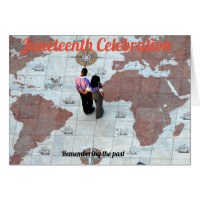
Juneteenth Greeting Cards


Juneteenth Day Celebration Greeting Cards that feature my new North Star Design and a few more Juneteeth Greeting cards options to help you celebrate this year's Juneteenth Day Celebration. There are for just about every other celebration held in America, cards that mark a special time, date, and special places. I believe Juneteenth Day Celebration cards should be among them as a way of keeping the important history behind this celebrated alive. My latest Juneteenth greeting cards hold message from the past that reaches out across the ages to tell about the sacrifices of so many, so long ago, the African Americans, and the none African American abolitionist who today enjoy the freedoms the message makers that I quote would not live long enough to witness.


Powered by Zazzle Affiliate Helper

Sunday, April 14, 2019

New Juneteenth Handbook Facebook Group


I have created a new Juneteenth Handbook Facebook Group page and you are invited to join with me and others to discuss and share information about the Juneteenth Day Celebration and its history. The New Facebook Group is looking for members willing to share their Juneteenth knowledge and Juneteenth stories to build a knowledge base about Juneteenth and the way different people celebrate the oldest African American celebration in the U.S.

Back when I worked at Stanford University at SLAC (the Stanford Linear Acceleration Center) I was part of an organization that set up the Juneteenth Day Celebration each year. Of my over 35 plus years at SLAC, there was a time when I first became aware of the Juneteenth Day Celebration and that resulted in my participating in the celebration the last 10 years of my employment SLAC. There were bands, T-Shirts, good food, friendly people and almost always someone there who was learning about the Juneteenth Day Celebration for the first time the way I did 10 years earlier.

The job I had at the television station where I first heard all the details behind Juneteenth, didn't celebrate Juneteenth. The thing that stuck with me when I did first become aware of what the word Juneteenth meant was that Juneteenth is "the Oldest African American Celebration in the United States." I remember thinking how could I not know about the oldest "African American" celebration around? History was one of my favorite subjects when I was in school so I found it highly unlikely that I had read over that important fact and not filed it away in my memory bank.

In the end, and after a little research, on my part, it turned out to be a relief realizing that I had not read past an important black history fact. The oldest African American Celebration in this country (the U.S.) truly had never appeared in any of the history textbooks I had studied in. Like I tell most of my friends my knowledge is history especially as it relates to slavery came from the years BC (before cable). The Internet is a great source of information nowadays but since not all the information I have come across that relates to Juneteenth and slavery has been reliable it helps to have more than one source of information about a Juneteenth/slavery question.

If you have anything you would like to share about the Juneteenth Day celebration, like how that day is celebrated where you are, or how you first became aware of the Juneteenth Day celebration please feel free to share that information to this new Facebook Group. 

Tuesday, February 19, 2019

The African Religion


In West Africa, where most of the slaves involved in the Atlantic Slave Trade came from, the religion of Vodun was practiced by at least 30 million people in Ghana, Togo, and Benin. Vodun, with its, numerous deities, spirit possessions, and animal sacrifices is one of the African religions that has, in my opinion, become the most misunderstood religions on this planet. In the eyes of people who bought and sold slaves the concept of paganism was used to justify the enslavement of African people and to separate them from their original religion.

In the Americas, the African religion of Vodun was renamed Voodoo and scorned by the none Vodun believers, made up of European and colonial slave owners and colonial slave merchants. The slave owners sought to do away with the ritual and tradition associated with the African religion and to perform a Christian conversion of their growing population of enslaved African people to the more refined and documented religion of Christianity. Over the years many slaves did let go of their religious umbilical connection to the motherland of Africa and grew apart from their religion that emphasized a more harmonious balance between the spiritual world and nature.

For a time many of the newly converted Africans still found ways to incorporate some of their African rituals into their Christian beliefs and in the South American places where they were left to practice their brand of Christian mixed with African religious way some of their African religious roots can still be found today. In North America, just about all of the African religious roots have disappeared, by separating the African American slaves from their cosmologies, rituals, and rites that they still clung to. Gone were their cultural expression, in song, dance, stories, and knowledge of the healing arts. As a result, Vodun turned Voodoo, continued to be demonized by the promoters of Christianity who viewed Voodoo as mere superstitions, that without a written text, was considered worthy only of being labeled heathen, and looked upon by the Christians as idolatry.

In fact, s variety of polytheistic religions had existed on the African continent for example, for centuries the African continent had fallen under Islamic influence so, in fact, not all African religions were without documentation (or written text) and not all the Africans shipped to the Americas were unable to read. The majority of African slaves may not have been able to read English, but many could read Arabic. Sprinkled throughout the colonies were small groups of practicing Muslim Africans that had a tendency to be pointed out by the slave merchants as exceptional slave labor groups. During the early part of the nineteenth century, a larger number of Islamic slaves would end up in northeast Brazil than all of the colonies and it would be the Muslim slave's that would provide a greater source of trouble and discontentment for their owners.

Portuguese missionaries had actually introduced European Christianity in places on the African West Coast in the fifteenth century making some slaves familiar with Christianity even before they were robbed of their freedom. The Old Testament spoke of the condition of the enslaved and nurtured within those slaves listening to the words of the bible the belief in future equality and freedom. Many of the slaves converting to Christianity would come to visualization Christianity as a possible way to freedom, and as more of the slave population converted to Christianity slaveholders came to the realization that one day the Christianization of the slaves might lead to a demand of emancipation.

In a way, the slave owners were right freedom was a word those who owned slaves didn't want to hear when it came to their slaves but eventually members of the churches, Quakers, Abolitionist, and American Indians would begin assisting slaves who would choose to emancipate themselves. Word had reached many slaves in the colonies that in Florida the Spanish held out the promise of freedom as a reward to any slave willing to undergo conversion to Christianity; which prompted the 1667 law passed in Virginia that stated conversion to Christianity did not change the status of a person from slave to free. As evangelicals and preachers drew more and more Africans born in America into the chapels and churches in North America their Christian conversion would just about do away with the religion brought to North America by the enslaved Africans. Through it all, some African descendant with the desire to hold on to the old African beliefs changed and adapted to their worship to their new circumstance.


That's why in places where the African descendants were given their own social space remnants of the old African religion can still be found in distinctive local forms like Santeria in Cuba, Voodoo in Haiti, Obeah and Myalism in Jamaica. These religious holdovers from Africa the stories, song, dances, and African religion are not to be feared in fact, it would not hurt for everyone, Christians included, to try and understand the religions forcible exported here hundreds of years ago. For those African beliefs still practiced on this continent, remember they are the last vestiges of the few possessions the African Ancestors taken from Africa were allowed to bring with them.