Showing posts with label Slavery. Show all posts

Wednesday, August 13, 2025

If History Were Taught Honestly: Liberia’s American Roots

History, African History, American History


Introduction
Juneteenth is about freedom—but it’s also about truth. It’s about telling the real story, not just the neat, edited version that makes us comfortable. Freedom without truth is fragile. And one truth that rarely gets told is the surprising connection between African Americans and the African nation of Liberia. This isn’t just a story about geography—it’s a story about forced migration, survival, resilience, and the power dynamics of who gets to write history.

If history were taught in its truest form, perhaps the White House would not have been so surprised recently about how well some Africans from Liberia speak English. The reality is, there’s a very clear reason why many Liberians speak English fluently and why so many of them carry American-sounding names. And while we’re at it, have you ever taken a close look at the Liberian flag? The resemblance to the American flag is undeniable—stars, stripes, and all. None of this is a coincidence.

Liberia, an independent African nation today, began its life as an American colony. It wasn’t just any overseas project—it was a calculated plan funded by the American Colonization Society, whose purpose was to send free African Americans and formerly enslaved people to Africa. In short, it was forced colonization under the guise of “opportunity,” and it left a complicated legacy that still shapes Liberia today.

In the beginning, things were far from easy. The settlers sent to Liberia were African Americans who, after generations in the United States, no longer spoke African languages, knew African customs, or had an intimate understanding of African societies. Imagine trying to “repatriate” white Americans to their European ancestral homelands after centuries in America—they’d be strangers in a strange land. These new Liberians were essentially cultural foreigners to the African continent, and the adjustment was anything but smooth.

The U.S., however, provided backing and support—financially, politically, and in resources. Over time, with persistence and determination, the small colony carved out on the West African coast began to survive, and eventually, to flourish. The relationship between the African American settlers and the indigenous peoples of the region was tense at first, but necessity and shared goals gradually built a foundation for cooperation.

If history were taught accurately in classrooms, Americans wouldn’t be puzzled about why Liberians speak English so well. Nor would they be surprised that Liberia’s capital, Monrovia, is named after U.S. President James Monroe. But here’s the trouble—when the historians who write the textbooks and the clergy who teach biblical history alter the truth, the public gets a distorted version of reality. And when the powerful control the printing presses, they can make sure the stories told fit their preferred narrative, even if that means inserting people into places they never historically existed.

The American Colonization Society itself was a strange mix of motivations. Some of its members were slaveholders who feared that free African Americans would inspire those still in bondage to rebel. Others were slave traders who wanted the Black population in America restricted only to those they could profit from selling. And then there were the well-meaning abolitionists, who, despite opposing slavery, believed that the only place African Americans could truly live free was in Africa.

A surprising fact to many: Confederate General Robert E. Lee—yes, that Robert E. Lee—helped finance the trips of some enslaved people he owned who wanted to go to Liberia. Over time, despite their rocky start, the settlers and the local Africans began to cooperate for mutual benefit. This cooperation eventually transformed the fledgling colony into a sovereign nation.

By 1847, Liberia declared its independence. And in designing their national flag, they made a clear nod to the country that had both displaced and created them—the United States. The Liberian flag’s red and white stripes, blue field, and single white star stand as a reminder of its American colonial origins.

Today, Liberia is unique on the African continent. Its official language is English. Many of its surnames—Johnson, Roberts, Jackson—echo American roots. And its flag, history, and political institutions bear the imprint of a country an ocean away. This shared history is an uncomfortable but undeniable part of both American and African heritage.

Conclusion
Juneteenth reminds us that freedom was fought for, not gifted. But it also reminds us that the fight for truth is just as important. The story of Liberia is proof that history is often more connected, more complex, and more revealing than the versions we’re handed in school. By telling it in full—without edits, without omissions—we honor not just those who lived it, but those still seeking freedom today. Because when we know the truth, we can see the ties that bind us… even across oceans.
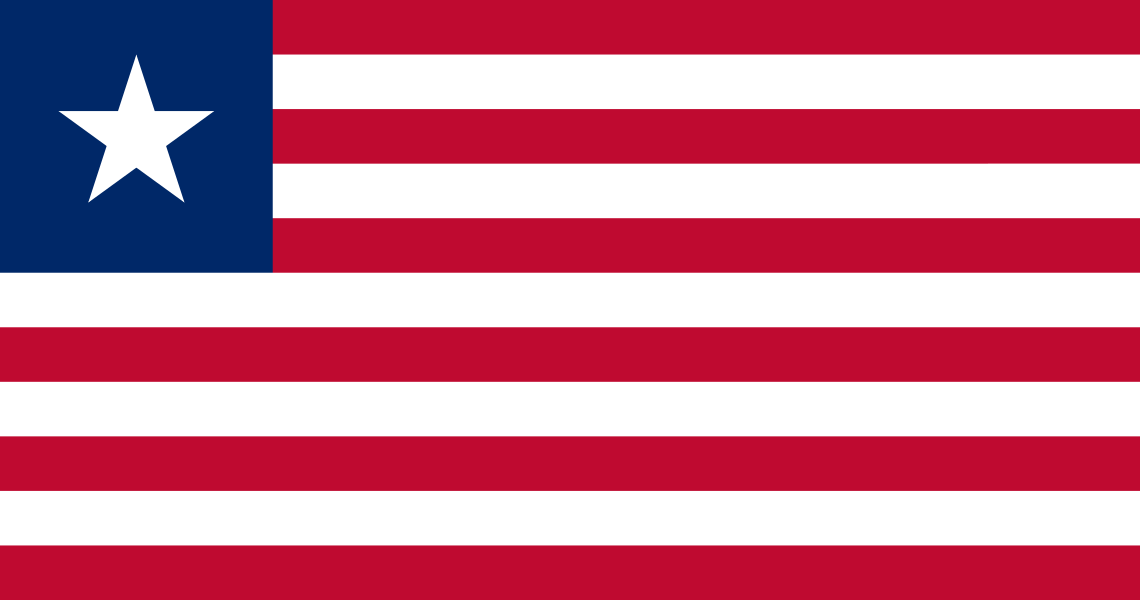
Liberian Flag

📜 Did You Know? Liberia’s American Connection

  • Flag Twins: Liberia’s national flag has red and white stripes, a blue square in the corner, and a white star—closely modeled after the U.S. flag. The single star represents Liberia as Africa’s first independent republic.
  • Presidential Namesake: Liberia’s capital city, Monrovia, is named after U.S. President James Monroe, a strong supporter of the American Colonization Society.
  • American English: English is Liberia’s official language, a legacy of its founding by African Americans and free Blacks from the United States.
  • Familiar Last Names: Many Liberians carry surnames like Johnson, Roberts, and Jackson—remnants of their American heritage.
  • Shared History: Liberia declared independence in 1847, making it the oldest republic on the African continent.
Juneteenth Flag

🔍 Discover More Hidden History

The story of Liberia is just one of many connections between African American history and the wider world. Our Juneteenth Handbook Blog is dedicated to uncovering the stories that textbooks skip—stories that change how we see our past, our culture, and our future.

Explore More Stories

Monday, May 5, 2025

How to Self Emancipate from Mental Slavery

Self Emancipation Post

How to Self-Emancipate from Mental Slavery

The history of slavery in America reveals a brutal system that enslaved people both physically and mentally. Physically, there were chains, overseers, and harsh punishments used to maintain control and obedience. Mentally, there were constant messages and reinforcements meant to degrade the enslaved and convince them of their inferiority. These included restrictions on education, laws that forbade reading and writing, and the widespread promotion of the belief that others were more intelligent, more capable, and more worthy.

Though physical slavery in America ended with the Civil War, mental slavery remained—and in many ways, it was just as damaging. When Southern lawmakers returned to Washington after the war, they worked to implement systems that would keep the races apart and keep newly freed African Americans poor, uneducated, and dependent. This was not true in every single case, but for the majority, the promise of freedom was followed by a new kind of bondage—poverty, illiteracy, and systemic racism.

Still, there were exceptions. Some African Americans had never been enslaved and had the opportunity to pursue education and own property. Others were the children of slave masters, and in some cases, they were freed through a legal document called a deed of manumission. These advantages, however, were the exception, not the rule. The vast majority of enslaved people were denied any opportunity for advancement or learning.

For some, the only path to freedom was through self-emancipation—a decision that came with enormous risk. Escaping from slavery could lead to capture, punishment, or death. Yet for many of our ancestors, it was the only choice that honored their humanity and hope for a better life. It's important to remember that not all Africans who were enslaved came from backgrounds of poverty or ignorance. Many, especially among the Muslim population sent to South America, were educated and highly skilled. In fact, some of them were more advanced in construction, mathematics, and language than their enslavers.

These educated slaves became a threat to the system. Fear of rebellion grew after the Haitian Revolution, when enslaved people in Haiti successfully rose up and established the first Black republic in the Western Hemisphere. The success of Haiti showed that freedom and independence were possible and sent shockwaves through the slaveholding world.

Today, self-emancipation is no longer about escaping physical chains—it’s about freeing the mind. Mental slavery exists when people internalize feelings of inferiority, powerlessness, and hopelessness. These chains are harder to see, but just as damaging. The first step to breaking them is to seek out knowledge, learn history, and reshape the way we view ourselves and our place in the world.

As our ancestors in ancient Egypt once said: Know thyself. This idea is more than spiritual—it’s practical. To truly know oneself is to understand one's worth, your power, your heritage, and one's potential. Mental freedom begins with self-awareness and is cultivated through education, critical thinking, and cultural pride.

So, how do you self-emancipate from mental slavery? You question what you've been told. You learn the truth about your history. You build confidence through self-knowledge and reject any notion that you are less than. Mental freedom is not given—it’s earned through persistence, courage, and the determination to live fully and freely.

Saturday, April 26, 2025

The Crittenden Compromise

Attempt to Save Slavery

Introduction

Juneteenth is a celebration of freedom, marking the day when the last enslaved African Americans in Texas learned of their emancipation. But the road to freedom was long and filled with political battles, compromises, and resistance from those who wanted to keep slavery alive. One of the last major attempts to preserve slavery in the United States was the Crittenden Compromise, a proposal introduced just before the Civil War. Understanding this compromise helps us see how close the country came to permanently protecting slavery—and why its failure was a crucial step toward justice.

The Fight Over Slavery and Citizenship

Juneteenth marks a major turning point in American history. Around the time of Juneteenth and the end of slavery in the southern United States, about 250,000 of the 4 million enslaved people in America were freed. The passage of the 13th Amendment soon followed, officially ending slavery and moving the United States Constitution a little closer to its promise that "all men are created equal."

The 14th and 15th Amendments continued this progress. Former slaves, once counted as only three-fifths of a person under the Constitution, were now recognized as full American citizens. These amendments promised equal protection under the law and voting rights, at least in theory. Although struggles continued, these changes represented a giant leap toward true citizenship and human rights for African Americans.

Why Juneteenth and July 4th Matter Together

Before Juneteenth, the Fourth of July did not fully apply to all Americans. July 4th celebrated the nation's independence, but enslaved African Americans were not included in that freedom. Today, because of Juneteenth, Independence Day can truly be seen as a celebration for all citizens. While July 4th represents the birth of a free nation, Juneteenth celebrates the freedom and independence of a people—Africans and African Americans—within that nation.

The Crittenden Compromise: A Desperate Attempt to Keep Slavery

As early as Abraham Lincoln’s presidential campaign, debates about how to handle slavery were heating up. Both anti-slavery and pro-slavery groups wrestled with how the nation should move forward. During this time, U.S. Senator John Crittenden of Kentucky introduced a proposal called the Crittenden Compromise, aiming to settle the growing divide between the North and South.

Even though many of the original Constitutional delegates were slaveholders, the Constitution never directly mentioned slavery. Leaders knew slavery was a major part of the American economy, but few wanted to confront it head-on—not even Lincoln, who was campaigning for the highest office. Instead, there were several efforts to "compromise," including proposals that would have officially written slavery into the Constitution itself.

Turning Back the Clock to Protect Slavery

The Crittenden Compromise tried to roll back time. It sought to bring back the old Missouri Compromise boundaries of 1820, which limited where slavery could exist. Additionally, it proposed a new constitutional amendment that would permanently protect slavery from any future federal interference. Essentially, it tried to guarantee slavery’s survival forever.

The founding fathers may have avoided mentioning slavery in the Constitution because it clashed with the ideas of liberty and freedom that the document was built upon. However, over the years, political leaders from both major parties—Democrats and Republicans—continued to avoid fully addressing the injustice of slavery. This political avoidance lasted right up until the outbreak of the Civil War.

The Crittenden Compromise’s Failure and the Road to Freedom

The Crittenden Compromise serves as a reminder that, even as the nation inched toward ending slavery, there were powerful efforts to preserve it. Just before slavery's collapse, politicians were still trying to embed it into the nation's highest law. Thanks to the courage of those who fought for freedom—and the eventual failure of compromises like Crittenden’s—America took vital steps toward justice, equality, and true independence for all its people.

Conclusion: The Fight for True Freedom Continues

The failure of the Crittenden Compromise was a major turning point in American history. If it had passed, slavery might have lasted much longer—perhaps even permanently. But its defeat helped pave the way for the Civil War, the Emancipation Proclamation, and ultimately, the 13th, 14th, and 15th Amendments. Juneteenth is a reminder that freedom was never freely given—it had to be fought for. Understanding the political battles of the past, like the Crittenden Compromise, helps us appreciate the significance of Juneteenth and reminds us that the fight for justice and equality is ongoing.


What Are Your Thoughts?

The Crittenden Compromise reminds us of how fragile progress toward freedom can be, and how vital it is to learn from history. What are your thoughts on this failed attempt to preserve slavery and its role in shaping the future of the United States? Share your thoughts in the comments below!

🔗 Join the Conversation: If you found this post insightful, share it with friends, family, or anyone who might want to learn more about the history behind Juneteenth and the ongoing journey toward freedom and equality.


Wednesday, April 9, 2025

Blue Jeans, Indigo and Slavery

My Canva design


The Untold History of Blue Jeans, Indigo, and Slavery


Denim, especially in the form of iconic blue jeans, is widely regarded as a quintessential symbol of American fashion. However, the commonly told origin story of denim tends to gloss over the deep and vital contributions made by enslaved Africans. A more truthful and inclusive history was explored during a panel discussion titled “Denim & The African Diaspora: A Legacy Untold,” which sought to unravel the complex, often overlooked roots of denim and its cultural significance.

While denim may be described simply as cotton fabric held together with indigo dye and rivets, it represents much more—especially in the context of American idealism and identity. It has become a fabric associated with resilience, work, and style, yet the foundational role that people of African descent played in its development is frequently ignored. The rich culture, creativity, and labor of African Americans helped shape denim into the global symbol it is today.

In its early days, denim and similar coarse fabrics were known by names like “Negro Cloth” or “Slave Cloth.” These were materials of low quality—made from cotton, linen, or hemp—and were designated specifically for enslaved people. Slaveholders used this fabric to dress those they enslaved, and it was often the enslaved themselves who sewed the garments. These early forms of denim were not seen as suitable for anyone but the enslaved, reflecting the deep racism embedded in even the clothing industry of the time.

Over time, the perception of denim evolved, albeit unevenly. There were periods in American history where wearing denim was associated with low social status or seen as unrespectable. However, as the 20th century unfolded, denim was reclaimed by laborers, civil rights activists, and later, artists and musicians as a symbol of protest, resilience, and solidarity. Today, it stands proudly as a core element of streetwear, hip-hop culture, and fashion worldwide.

The connection between denim and African American history runs deep. Denim is not just a cultural product—it is a historical artifact woven with the threads of forced labor and resistance. The exploitation of enslaved people fueled the early fashion economy, and even today, much of the garment industry continues to rely on underpaid or forced labor. The same systems that made “blue gold” a prized commodity are still at play globally.

Even the deep blue hue of denim, the indigo color that makes it so recognizable, has roots that trace back to West Africa. The dye comes from the indigofera tinctoria plant, native to the region. As the transatlantic slave trade intensified in the 1700s, enslaved Africans brought with them knowledge of indigo cultivation and dyeing techniques. This expertise was exploited on Southern plantations, where indigo became one of the most profitable cash crops—so valuable, in fact, that it was once used as a form of currency.

Long before cotton dominated Southern agriculture, indigo reigned as the top export. Its commercial success helped establish and sustain the economies of slaveholding regions, cementing the role of slavery in the global fashion economy. The cultivation of indigo and the production of denim are thus inextricably linked with the experiences of enslaved Africans and their descendants. Every pair of blue jeans carries with it a piece of this legacy.

In re-examining the history of denim, it’s crucial to tell the story—one that honors the untold contributions of African people and recognizes the painful truths behind what is now a celebrated fabric. Denim is not just about style; it’s a mirror of America’s complex history of oppression, innovation, and cultural transformation. Understanding this story offers a deeper appreciation of the fabric and the people who helped shape its place in the world.


Thursday, November 3, 2022

Note about the Atlantic Slave Trade

Canva Slave Trade Art


The Slave Trade When it came to slavery and the slave trade in America (in the form of the colonies) America should not be standout. America was one of the members of the worldwide slave trading market. During the days when slavery was, a trading commodity ships flying the flags of many different nations were committed to the global slave economy and Africa was not the only donor to the slave trade. 


In fact, the first European ships traveling to Africa brought slaves to Africa to trade for Africa's riches of gold, diamond, ivory, and more. African slaves taken from Africa were taken to the east by Muslim slave traders into the Sahara and to the west coast of Africa by African slave traders where the slaves were shipped across the Atlantic Ocean to become part of the Atlantic Slave trade. Africa itself used slaves in its own economy. 

 
Eventually, the worldview on slavery would change and set in motion a chain of events that would eventually lead to the abolishment of slavery almost everywhere in the world. I have always looked at the Juneteenth Celebration as a way to honor all of the African ancestors who only knew life in chains during their lifetime and the several generations of American Africans that would follow them. Juneteenth is also the perfect time to honor all of the black Americans who first fought for the freedom of this country and the July 4th, 1776 celebration without being recognized as citizens of the nation, United States, they were fighting for and, who would later fight in the Civil War for this nation and their own freedom. 


I would also include American Africans like Nat Turner and others who chose to self-emancipate and also fight for their freedom. History is a timeline that should not be hidden or altered in any way that hides the truth. People should be allowed to learn that not all white people owned slaves and that not every black person in the United States was a slave, during the days of slavery. 

 
They should be able to learn about the abolitionist, the majority of which were white, who had just as much reason to celebrate Juneteenth as the ex-slaves did. Both groups wanted to see slavery end. A good place to start would be by doing away with two of the three blads of truth we now use your truth, my truth, and what really happened, which should all be reduced to simply, what really happened.

Monday, May 24, 2021

Should the History of Slavery be Taught in school?


Should the history of slavery be taught in school is the question this post poses, an idea that came to me after reading a recent news report that said some politicians were trying to ban the teaching of the history of slavery in the classroom. It is my belief that studying history can help with making better decisions and judgments. History teaches us all how to learn from our mistakes (there is no success like failure:-) History shows us models of good and bad citizenship and helps us understand societal development and change. There is even some evidence that history not learned will be repeated. 

When I was in school, I would have loved to learn about how the first generation of former slaves was able to complete far fewer years of schooling, on average, than white students. In fact, it would be years later when I would realize that the school life I knew growing up in the 60s out here on the west coast was nothing like the school life my mother's sharecropping family experience in the deep south. While gathering information from my mother to ghostwrite her book that a stroke took away her ability to do, I learned that her sharecropper family wasn't allowed schooling during the harvest season.

In a lot of ways, sharecropping replaced slavery when it came to oppressing African American education, and no matter how hard a sharecropper family worked during the year the average sharecropper family usually ended up owing more than they earned each season. Regular schools in the south in the 60s believed that separate but equal was an education plan that worked best. For most African Americans that plan led to a qualitatively inferior education. The history of which, in the 1960s brought about social change that put a spotlight on the fact that separate was not equal when it came to education.

How soon should children be taught about slavery? For a subject some want to avoid altogether I would say at the age of 5, with child-friendly images that are not graphic but honest to the experience of slavery. A history where the better angels of humanity destroyed slavery in the U.S. only helps us develop a better understanding of the world in which we live, and to me, that is a big plus. Especially if we could now turn that energy that destroyed slavery toward the new enemy of racism.

The reason we need to learn about slavery in school is the history of slavery is part of American History that can help young minds be better equipped to deal with dilemmas and complex questions that their own children may ask one day, and to determine how our past in the shape of monuments, flags, and long-held beliefs still shapes local, national, and global relationships between people and societies.

Building a better knowledge of Black History, including slavery,  that leads to understanding the events and trends that have brought us from the end of slavery in the United States to where we are today is the best way to safeguard freedom and ensure the words of the constitution that read all men are created equal.