Friday, January 21, 2022

Queen of the Kushite Kingdom


Queen Kandake Amanirenas would lose an eye in battle, cover it with a patch and continue to lead her armies against the mighty Roman Empire. Kandake or Candace means "Great Woman" and is the equivalent of queen or queen mother of the kingdom of Kush. From what I have been able to learn about this lady she was indeed a great female leader and was the leader of the kingdom of Kush, located in modern-day Sudan and Ethiopia. Born between 60 and 50 B.C. she reigned as the sole ruler of Kush

Queen Amarnirenas would impress even the Roman war generals in defense of her kingdom. The Romans were on a drive to expand their empire and their wealth by demanding tribute from the Egyptians and the Greeks whose lands the Romans had conquered. The problem for the Romans came when they decided to include the African people living in the Kingdom of Kush.

Unlike Cleopatra, the Kushite Queen would not bow gracefully to the Romans' demands, Queen Amanirenas chose to protect her people from paying tribute to the Romans. Rather than give in to the Romans' demands and ultimatums the African queen went to war with Roam. Leading a skillful group of attacks Queen Amanirenas with thousands of her soldiers shocked the Romans by boldly attacking Roman territories.  To show her distaste for the Roman Emperor she and her army dethroned statues of the Roman Emperor Augustus Ceasar (24 B.C.)

Queen Kandake Amanirenas beheaded a statue of the Roman Emperor and buried it under the entryway of her palace so that everyone could walk over her enemy. This disgraceful slap in the face was yet another source of anger for Augustus Caesar to learn that Nehesu will have to walk over the mighty emperor's head to enter the kingdom of Kush. Unable to defeat the Queen of the Kushites and tired of spending large chunks of their newfound riches to eradicate the elusive battle harden queen, the Romans called for a truce.

In the end, a deal would be struck between the Romans and the Kushites that amounted to Queen Amanirenas agreeing not to attack or deface any more Roman settlements or cities and in return, the Romans would not seek tribute from the Kushite Kingdom. The riches of the Kushite Kingdom would stay within the African people's Kingdom thanks to the Kushite Queen, Kandake Amanirenas.

 

Friday, January 7, 2022

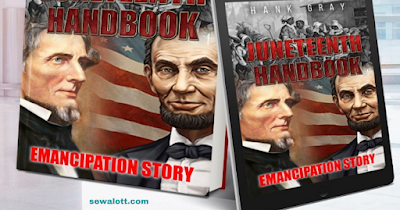
The Juneteenth Handbook

Emancipation Story

The Juneteenth Handbook was put together by me to share my very own personal experience about attending my first Juneteenth celebration, and to share some interesting information about the Juneteenth celebration collected during my research stage for this book's companion video/DVD A Time to be Remembered, A Juneteenth Story.  My handbook also offers a brief history of the Juneteenth celebration that includes many of the people, places, and things associated with the oldest celebration of the end of slavery in this nation. Much of this history I did not know before starting my Juneteenth knowledge-gathering journey.

My other motivation behind this handbook was the joy of knowing that some of these interesting Juneteenth snippets, cut from my video production because of time considerations, would not be lost to the editing room floor. The fact that Juneteenth is currently a federal holiday is amazing to me and was one of the driving forces for me creating the video, and the handbook, thinking that if enough Americans became aware of the truly historic significance of the Juneteenth celebration it might help tip the scale all the way over to; make Juneteenth a national holiday.

In my retired life, I realize that I not only love history, but I also love uncovering hidden history. So far, it's been history hidden from me, I'm sure if my college days had bent more toward African American history rather than electronics, the history I am learning about today would have shown itself to me much earlier. Still, many of the things I have learned about slavery and the Juneteenth celebration these days I wish I had known when I was in school.

The truth of the matter is that the Juneteenth celebration, which culminated with the passage of the 13th, 14th, and 15th Amendments did something the July 4th, 1776 celebration did not do. The Juneteenth celebration made the United States a more perfect union because, on June 19th, 1865, all Americans, black and white, were finally entitled to equal protection under the laws of this nation, something that was not true on July 4th, 1776.

The thing to remember is that Jubilee Day, Freedom Day, Emancipation Day, just some of the other names for the Juneteenth Celebration, is an important part of American History and is considered the longest-running African American, and end of slavery celebration in the U.S. North Dakoda, and Hawaii used to be part of the last three states in the union with no prevision to celebrate Juneteenth. Each of those states has since approved legislation to honor Juneteenth as a State Holiday leaving South Dakoda the only no Juneteenth celebration holdout.

Monday, November 29, 2021

The way black history is colored


The way black history has been colored over the centuries would lead a lot of people to believe that black people (in particular African Americans) didn't have much of a history that wasn't connected to slavery. But nothing could be further from the truth. Think about it, if all humanity emanated from Africa and spread throughout the world the only way current thinking about African Americans and civilization would be true was for there to be no early civilization in early Africa, and that is the African history that must be unlearned.

Not only was their early civilization in Africa, but the continent of ancient Africa was once a world trading power, trading its resources of gold, diamonds, and produce with the rest of the known world in ancient times which included the Americas. African civilizations build the pyramids, ruled Egypt, and the Kindom of Kush thousands of years before European civilization existed. 

Then came the colonizers Belgium, Spain, France and more using their high-tech technology in weapons to take over large parts of Africa's riches, included Africa's people. Slaves were first brought into Africa and traded for Africa's bounty before the Atlantic slave trade would begin to drain Africa of its generations to feed the growing need for labor in the Americas. Spain and France supplied African slaves to South America and the British eventually became the major supplier of Africans to the newly developed North American colonies.

Where once African resources were controlled and sold by Africans, colonization cut deep into most of the African economies, and over the years the constant drain of African people to the slave trade and African resources to the colonizers would leave most of Africa at the mercy of its colonizers. Eventually, Great Britain would reanalyze its role in the slave trade and end its participation in the taking of people out of Africa. A revolution in France would bring about the French giving up its slave trade, which was followed by the Haitian Revolution and the French selling its Louisiana Teriorries to the colonies. After the Civil War, the Atlantic slave trade to the colonies turned states was ended.

Colonization continues to this day in Africa and parts of South America. Today Africa seems to be on its own build-back-better plan, and while Africa's future, with regard to colonization is TBA (to be announced) the history of Africa's greatness and the African Americans connection to it, though their ancestors, should be taught in schools.

I think the history of the ancient world as it relates to black people would not only be informative but very spiritually uplifting to Americans that suffer from the misconception that African American history starts with the end of slavery in this country. An effort should also be made to show modern Africa as it is today, complete with the Bushman's funny surprise attacks on unsuspecting African people living in the city. The truth about Africa's past and present is often not televised by mainstream media, or talked about in school books, Africa is not all third-world-county.

While a lot of the negative images from mainstream media are true they don't show the modern clean streets of Africa cities like Kigali Rwanda which should also be in the mix of things colonization media wants you to know about the mother land. Slavery may have taken the descendants (us modern-day African Americans) away from any African roots that can still be traced it should not be allowed to keep African Americans from knowing Africa. African Americans, and Americans in general, should understand why so many major world powers don't want Africa to achieve the world power status it once held in ancient times.

And why many of those world powers feel pretty much the same way about the Island Nation of Haiti where the slave population overthrew colonial rule to rule as an independent black nation on their own. You would think that nations based on "freedom" would view the Haitian Revolution as a success for freedom. Africa's true history, The island of Haiti, as well as other nations who have released themselves of colonial rule may not be the kind of historical success story fit for the colonial narrative, but they are still African historical events that deserve a place in American history school textbooks, if you ask me. 

once-upon-a-time, black people, slaves, were forbidden from learning: no reading, no writing, because that knowledge was power. Imagine if that same sort of effort was applied to black people, ex-slave ancestors today, when it came to learning the true history of Africa's early civilizations and racism in America because that knowledge is powerful too? School should be the proper place for learning history but what do you do when a small number of American, don't want taught from the classroom to the majority of young Americans, the truth about Africa's early civilizations or facts about American racism? Well, there's always the internet.

Monday, November 1, 2021

African Civilization older than European civilization.


It boggles my mind that there are those who would resist teaching American History in American classrooms where it relates to slavery, that resistance made me realize that most of my growing up years I was privy to more information about what African American people couldn't do than could. Even if history is not always written by the victorious it should still be accurate. A society that cannot learn from its own mistakes must surely not be teaching its own true history.

School-age generations of children should know about the dark days of slavery in the United States and the rest of the world. It would have been helpful for me when I was in grade school to know about all of the white people, working alongside black abolitionists to build a resistance movement that would eventually topple slavery's empire in the U.S., and to know about black union soldiers fighting for their own freedom and ours.

I do know that the study of African American History when I was in school would have been one of my favorite subjects. Instead, most of my real learning about African American History came just before I graduated college and into my adult life. I remember thinking that if people are writing that Africa is the birthplace of mankind shouldn't it be obvious that following the history from Africa into Europe would be the logical progression of the historical scholars?

When I was a kid all of the heroes from Africa (like Tarzan) were white, watching movies like the Ten Commandments showed me that all of the Egyptian people were white with very dark makeup tans. There were some black and white people in that movie who were slaves. When I was a boxer, as a kid, at the local gym in Hunters Point, I remember asking my trainer, retired boxer Hard Punchin' Herman Henry, why there were no black quarterbacks in the NFL? I didn't even consider a black coach, back then. He told me "eventually there will be black quarterbacks and when that happened every NFL team would want one."

I realized that like the movie business, the NFL also colored things the way it wanted to see things. I'm sure Cecil B. DeMille didn't see Harry Belafonte, James Earl Jones, or Sidney Poitier as lead material for his classic movie production but I would surely have had the above black actors read for one of the roles:-)  Slavery was replaced by racism and the lack of opportunities institutional racism provided for African Americans extended even to the NFL back in the late 60s early 70s. Replace the word black with good and I realize what my Parks and Recreation mentor was saying to me. All NFL teams want a good quarterback no matter what their skin color.

The good news is that over time like the turbulent days of the 1960s things started to change in the movie business for African Americans and even in the NFL. Nowadays there are black actors in leading Hollywood roles, black quarterbacks, and coaches so my hope is that there will also be black history classes in schools so that Africa's true history can be learned. History that unravels the lies, half-truths, and misconceptions of the African colonizers so that Africa's true history up to and including the Atlantic Slave Trade can be a part of the ongoing teaching of American History in American schools.


Tuesday, August 24, 2021

Juneteenth Freedom Day


Emancipation Day, Freedom Day, Black Independence Day, Jubilee Day, Officially Juneteenth National Independence Day are some of the other names for Juneteenth. On June 19th, 1865 the United States moved a step closer, as a nation, to honor the words written in the U.S. Constitution about all men being created equal. To Fredrick Douglass and his abolitionist colleagues, Abraham Lincoln's Emancipation Proclamation wasn't passing the truth test. When the truth about the Emancipation Proclamation was known it became clear the document completely overlooked all of the slaves in friendly northern states so: what to the northern slaves was the Emancipation Proclamation on June 19th, 1865? 

Not much, and especially not a document of freedom for the slaves in friendly union states. By the end of that year (1865) that oversight would be remedied with the passage of the 13th Amendment, and the following year, 1866, on the one-year anniversary of General Gordon Granger's reading of General Order No. 3 the first official Juneteenth Celebration was held. This time ex-slaves, north and south, could participate in the freedom celebration because it was the 13th amendment that abolished slavery everywhere throughout the United States. 

The following year in June congress would pass the 14th amendment, which was ratified in July 1868. The 14th amendment made the ex-slaves citizens of this nation they had sacrificed their African identities for and toiled as slaves for more than 400 years. In my opinion, the most important part of the 14th amendment is the equal protection under the law the 14th amendment gave to the ex-slaves and their descendants.

The 14th amendment did much to help form the more perfect union referred to in the constitution and the reason I believe Juneteenth is the true National Independence Day. When asked to speak at a 4th of July celebration Frederick Douglass asked in his speech: what to the slave is the 4th of July? Because not only were the enslaved Americans not free at that 4th of July celebration, celebrating freedom from British rule, those same slaves were not considered citizens of the nation so many had fought and died for in the colonial war.

The 13th amendment made it possible for blacks and whites to celebrate a national independence day. Freedom from British Rule and Freedom from slavery, reduced down to its lowest denominator, freedom. The name chose for that new National Independence Day was Juneteenth. That is how all of the above appears to me anyway.

Slavery needs to be talked about in our schools, up to and including the end of slavery because the slave trade was a big part of American History, in much the same way slavery was part of Roman and British history as well as dozens of other world powers. New and better school textbooks are needed, more detailed than the textbooks I had in school along with teachers willing to teach history the way American history really was. Juneteenth and its rise to a national holiday should also be included along with the people and politics to make it happen because while Juneteenth is now a federally recognized National Holiday it is still illegal to teach about Juneteenth in more than a dozen states.

Saturday, June 19, 2021

Juneteenth 2021 The First

Ladies Juneteenth Picnic


The Juneteenth 2021 Celebration will be a little different from all of the other Juneteenth celebrations that have happened before now because the year 2021 celebration will be the first time Juneteenth is celebrated as a national holiday. Just like the years of hard work, dedication, and prayers that led to ending slavery in the United States, the years of hard work, dedication, and prayers to make Juneteenth a national holiday have finally become a realization. 


Flag Girl


Only, unlike the news about the Emancipation Proclamation, that was withheld from the slaves in the southern U.S. for two years, notification of Juneteenth reaching national holiday status was instant, given today's technology, catching many people, myself included, off guard. Talk about making Juneteenth a federal holiday had been going on ever since I first became aware that the juneteenth celebration existed.

To be perfectly honest I had started to believe that because of today's highly polarized political climate debate in Washington DC about making Juneteenth a national holiday would once more be batted around and once more tabled, tossed aside, forgotten. News of President Joe Biden finally signing the Juneteenth Celebration into the history books came as a total surprise.


And the name Juneteenth National Independence Day has a nice ring to it since on July 4, 1776 the majority of black people living in the colonies were still slaves and not considered citizens of the same nation they fought for in the colonial war, and in the Civil War. June 19th, 1865 was the date that freedom for African American people in the United States began followed by the 13th Amendment that abolished slavery everywhere in the U.S., and the 14th Amendment granting citizenship rights and equal protection under the law to the ex-slaves.

I would love to have been able to learn the above historical facts when I was in grammar and Jr. high school. When I was in grade-school I had no ideas about a Juneteenth celebration. My parents (from Louisiana and Texas) seemed more interested in forgetting about their life experinces growing up in the Jim Crow south than sharing them.

For the sake of the African Ancestors, the history of slavery in this nation should not be forgotten. It (slavery) did after all happen, and African American people in this country have suffered from the end of slavery aftereffects since June, 19th 1865, and the so-called re-construction period. For the naysayers who might think that learning about slavery might evoke too many unflattering images of the way some white people used to treat black people, I say this would be an excellent opportunity to learn about all of the white people that did not support slavery and the contributions they made that would eventually bring slavery to an end in the U.S. 

Juneteenth is truly a National Independence Day because what started on that day and ended with the passage of the 13th Amendment did make that a day of freedom for the entire nation and the words in the constitution finally true for everyone, that all men were created equal and treated equally under the law.


Friday, June 11, 2021

The African Ancestors

The blessings of the ancestors are greater than those of living human beings. It's important to remember that as you do for your ancestors, your children will do for you. Slavery created countless forgotten family memories for the African Americans whose families had been pulled apart, with family members scattered by the wind. The end of slavery in the United States did very little to mend the African American family. 


Families could still be separated by circumstance because newly freed slaves hand nothing. The Freedmen's Bureau was set up to assist the ex-slaves but it did not work. Most slaves ended up returning to their former masters as laborers and sharecroppers in an agreement that almost guaranteed their ability not to prosper. The system former slave owners set up meant most sharecroppers could work the entire year and still end up owing most if not all of their money to the former slave owner.


When I think about the African ancestors, I end up feeling that in spite of the fact they were no longer amongst the living they were the lucky ones. Those who chose to be drowned rather than be carried away from home and into the unknown, and all of the drowned slaves, who through no choice of their own, were purposefully drowned because of sickness or to prevent a slave ship captain from being caught with slaves on board his vessel during a surprise boarding by the British or American governments, tasked with maintaining a blockade to prevent new slaves from being shipped to America. 


African and African American ancestor's souls, that had long since found their way back to the motherland were spared the days of slavery in the U.S., and even though we do not speak the language of our ancestors, hundreds of years later African Americans today can still feel the unwelcome heat of racism the ancestors learned to live with. Everything that made our African ancestors unique in their clothing, their language, their religion, and their families were taken from them upon arrival in the United States.


Out of that social and cultural deprivation for colored people associated with slavery in the United States came today’s modern-day Americans of African descent, like me, that honor our ancestors with events like the Juneteenth Celebration. In the African world and cosmological view of life, the ancestors are forever alive. It is said that the ancestors do things like connect Africans to their beloved ones, bless their fertility, even intervene when there is a spiritual blockage or polluting elements that threaten happiness, order, health, and life.

Our African slave ancestors came from a continent that consisted of a mixture of countries and various tribes that each possessed their own unique characteristics which in my opinion, is not only worth celebrating but worth studying as well. While I have not yet gone to African Ancestry and submitted any DNA to be traced back to the continent of Africa I have for a long time been able to trace my family roots back to the state of Texas, the birthplace of the Juneteenth Celebration and the home of many of the ancestors I celebrate.